

The Beautiful Chaos of Unplanned Learning: A Love Letter to Educational Wandering
Or: How I Learned to Stop Worrying and Love My Certificate Collection
Remember that carefully crafted September curriculum I designed and shared? My beautiful, colour-coded roadmap to professional development that looked so perfectly reasonable on paper - in this case, a Notion page carefully curated (it took me about four hours to colour co-ordinate and find stunning pictures (courtesy of Pinterest). Well, plot twist - life had other plans. And honestly? Thank goodness it did.
Here I am, three certificates richer than planned, knee-deep in two more courses, and somehow having accumulated what feels like a small educational empire that looks nothing like what we originally mapped out. My neurotic planner's brain should be having a meltdown, but instead, I find myself marvelling at something far more interesting: the sheer poetry of unplanned learning. Because somewhere between "I'll just peek at this one course" and "wait, how did I end up with three new certifications this month," I stumbled into understanding something about how my brain actually learns.

There's this fascinating thing that happens in the ADHD brain that explains so much about my September-that-never-was. Research shows we have a deficiency of dopamine, that magical chemical messenger that drives motivation, learning, and reward. But here's where it gets deliciously complex - and where the real story begins. (You should know one of my current courses is on understanding ADHD -Research and Practice offered by King’s College London, fabulous course).
Now as I was saying, when something clicks, when interest is sparked, the brain can lock into what scientists call "hyperfocus" - intense, prolonged concentration that can last for hours. Suddenly, that random course on accessibility design becomes a four-hour deep dive. That casual "I'll just peek at this EdTech certification" turns into a weekend-consuming passion project. The ADHD nervous system, as Smart Kids with Learning Disabilities notes, can "get in the zone" of amplified dopamine production multiple times each day.
So is this instant gratification? Maybe. Is it the way my neurodivergent brain naturally seeks the stimulation it craves? Absolutely. But it's also something more, that gets at the heart of what learning really means when we strip away all the institutional scaffolding and ask ourselves: why do we actually pursue knowledge?
Because let's be real for a moment and address the elephant in the room - am I just collecting digital badges like some kind of educational Pokemon trainer? The question haunts me sometimes when I look at my growing folder of completion certificates. There's this sobering research on what scholars are calling the "commodification of education" - the transformation of learning from a deeply personal, transformative process into something that can be "traded, bought, or sold in a market." The paper I found puts it starkly: "When education is nothing other than a sector of the economy producing knowledge... the commodification of cognitive activity... radically alters educational practices and what it means to know."

Watercolour illustration of a woman in a hoodie, headband back, sitting at a wooden desk in a sunlit study
Ouch. That hits different when you're staring at your LinkedIn profile and wondering if you're contributing to the very thing you critique in your EdTech work. When I see those "complete 30 courses to get this badge" gamification schemes, or watch platforms turn learning into engagement metrics and completion rates, I worry. Am I feeding that beast? Is my certificate collecting just another symptom of education-as-commodity, where the credential matters more than the knowing?
But then I think about what actually happens when I'm deep in one of these courses, and I want to push back on that narrative. Because my brain doesn't learn in neat semester-long chunks. It learns in spirals, in sudden bursts of "Oh my GOD I need to understand everything about this RIGHT NOW," followed by periods of integration and reflection. Traditional education systems were designed for neurotypical brains that can sustain moderate attention over long periods. My brain? It needs the feast-or-famine cycle of intense interest. And when I abandon that September curriculum for an unexpected deep dive into AI ethics, or when I find myself simultaneously enrolled in three different accessibility certifications because they all sparked something different, I'm not being impulsive - I'm honoring my neurodivergent learning patterns in a world that's finally making space for them.
The research on ADHD and learning shows that dopamine release strengthens neural pathways, making us more likely to repeat behaviours that give us that neurochemical reward. My certificate collecting isn't just about external validation - it's my brain literally rewiring itself for continued learning. Each time I complete a module that genuinely engages me, I'm not just checking a box; I'm building stronger connections between concepts, reinforcing the neural architecture that lets me do the complex work of building RAG systems and inclusive AI tools. The certificate at the end? That's almost incidental to the dopamine-fueled learning journey that got me there.
And here's what's truly beautiful about this whole messy experience: the plans I made weren't wasted. I’d like to think they provided a framework, a launching pad in the unexpected tangents and spontaneous discoveries that my ADHD brain insisted on exploring. As someone building RAG systems and working in EdTech, every one of these "distractions" has added layers to my understanding in ways that following a rigid curriculum never could have. That accessibility course informed my approach to inclusive AI design. The ethics certification deepened my perspective on responsible technology implementation. The extracurricular on neurodiversity? Well, it's literally helping me write this post with more self-awareness than ever before, connecting my personal experience to broader patterns in how we think about learning and difference.
This is where it gets complicated, though, because I'm living in this tension between two truths. On one hand, yes, there are absolutely valid concerns about the commodification of education. The Observatory on Education warns that education becomes "a commodity to be purchased," raising critical questions about the essence of teaching and its role in society. When learning becomes just another product optimised for consumption, when knowledge gets reduced to bite-sized modules designed for maximum engagement rather than deep understanding, we lose something essential. I see this in EdTech all the time - the pressure to gamify, to make everything "sticky," to optimise completion rates rather than actual learning outcomes.
But on the other hand - and here's where my forward-thinking brain gets genuinely excited - we also live in an unprecedented era of learning accessibility. Never before in human history has high-quality education been so democratised, so available, so... possible for brains like mine. I'd argue that open access to learning resources is actually the opposite of commodification - it's the democratisation of knowledge that was once gatekept by institutions that never really knew what to do with neurodivergent learners in the first place. If I want to earn seven certificates in five months because my hyper-focused brain finds deep satisfaction in mastering new concepts rapidly, I can do that. The internet doesn't judge my learning style - it just provides.
Traditional education asked us to go deep slowly, to follow predetermined paths, to demonstrate mastery in standardised ways that often had more to do with executive function than actual understanding. But neurodivergent learning often goes deep quickly, then connects laterally across domains in ways that look chaotic from the outside but feel perfectly logical from within. My certificate collection isn't evidence of shallow learning but evidence of a brain that finds patterns across disciplines, that builds understanding through diverse input streams, that learns by weaving together insights from unexpected places. For example, the accessibility principles from one course inform the AI ethics framework from another. The neurodiversity research deepens my understanding of inclusive design.
Do I feel pressure to keep learning, to keep proving competency through credentials?
Absolutely.
The modern professional landscape demands continuous upskilling, and there's definitely an element of anxiety driving some of my educational pursuits. I'd be lying if I said there wasn't a voice in my head whispering "keep up or fall behind" every time I see a new certification opportunity. As an AI/ML Integration Strategist in a field that's evolving faster than anyone can reasonably track, that pressure is real and constant. But there's also pure joy living alongside that anxiety. The joy of a brain finally given permission to learn the way it wants to learn. The joy of following intellectual threads wherever they lead. The joy of living in an era where "I wonder about..." can be followed by immediate exploration, where curiosity doesn't have to wait for the next semester to start or the right course to be offered.
So here's what I'm learning about the marvel of making plans within distraction: the plans aren't really the point. They're the trellis, not the vine. They give structure for the wild growth to climb, but the life of the thing - the actual learning, the real transformation - happens in all those "unplanned" moments of genuine engagement. My September curriculum has become an adventure from September through December, following my fascination, and every detour has taught me something that the original plan couldn't have anticipated. Because I couldn't have known in August which topics would spark that hyperfocus, which concepts would connect to unlock new understanding, which skills would suddenly become urgent and essential.
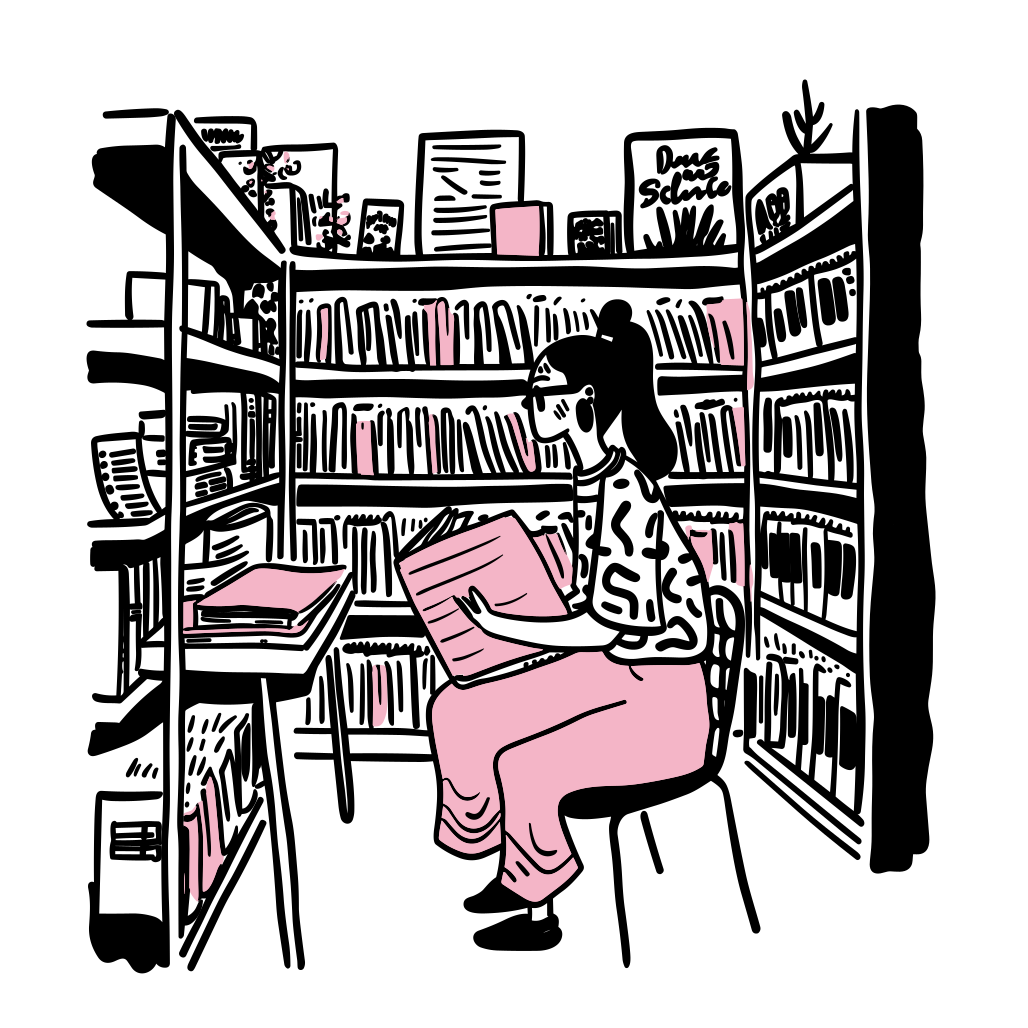
Woman in Library
What looks like chaos from the outside, the abandoned plans, the multiplying certificates, the simultaneous enrollment in seemingly unrelated courses, actually has its own wisdom when you understand the neurodivergent learning pattern at play. My brain is building a knowledge web, not a knowledge ladder. Each thread connects to others in ways that won't be fully visible until much later, when suddenly I'm in a meeting about RAG system architecture and insights from three different "unrelated" certificates come together to solve a problem no one else saw coming.
The certificates on my wall don't just represent completed courses - they represent a brain finally given permission to learn authentically, voraciously, joyfully. In a world that's increasingly commodifying education, maybe the most radical act is learning for the pure pleasure of knowing, following your neurological wiring instead of fighting it, trusting that depth and breadth aren't opposing forces but complementary patterns in different kinds of minds.
And if that makes me a certificate collector? Well, I'll wear that badge proudly - right next to all the others, in whatever arrangement makes sense to my beautifully chaotic, pattern-seeking, hyperfocused brain. Because somewhere between the plan and the chaos, between the pressure and the joy, between the commodity and the democracy, I'm learning to trust my own learning. And that might be the most valuable education of all.
And that's my update on the September curriculum. I hope to write again soon, with all the best intentions and numerous things sitting in my drafts. Till next time.
Reita
What's your learning story? Do you find yourself following unexpected educational paths, fighting against or flowing with your natural learning patterns? I'd love to hear about your own adventures in authentic learning in the comments below.